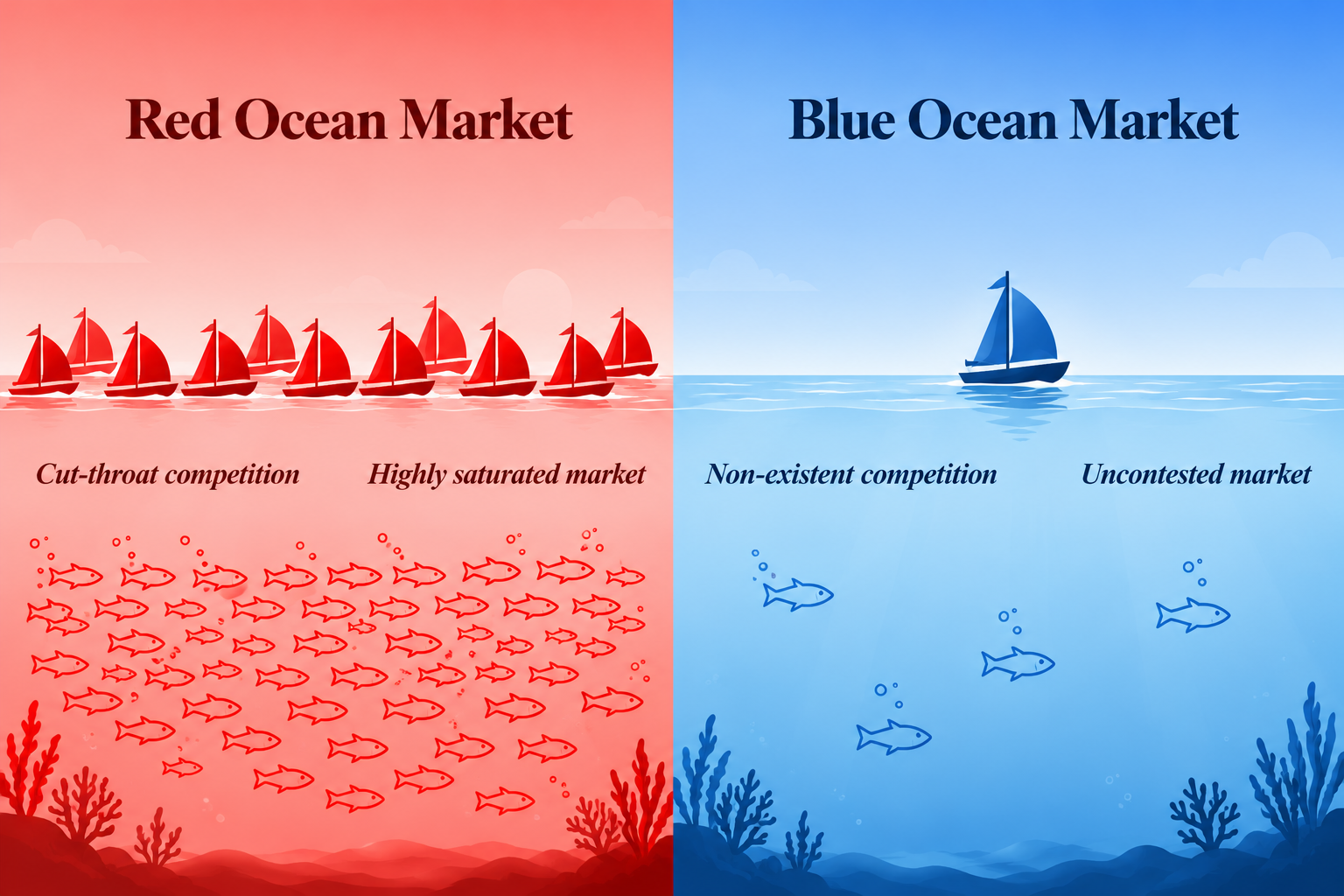
Most businesses operate in what W. Chan Kim and Renee Mauborgne called Red Oceans: established markets with defined boundaries, known competitors, accepted rules and a finite pool of customers.
In a Red Ocean, every company fights for the same customers using the same weapons: lower prices, better features, faster delivery, louder marketing. The water is red because every player bleeds margin to win share from the others. The total market does not grow. The share simply shifts.
A Blue Ocean is the opposite. It is a market that does not exist yet. There are no competitors because nobody has created the market. There are no customers because nobody has shown them what they need. There are no rules because nobody has written them. The company that creates a Blue Ocean does not capture market share. It creates market space. And for the period between creation and imitation, the creator operates in something close to a monopoly, with the pricing power, the margin and the growth trajectory that a monopoly provides.
The distinction is not academic. It is the difference between a Rs 50 crore company growing at 8% per year by fighting for 1% of incremental share in a Rs 5,000 crore market, and a Rs 50 crore company growing at 40% per year by creating a Rs 200 crore market that nobody else is serving.
Why Red Oceans eventually drown everyone
A Red Ocean market has a structural problem: the more competitors enter, the more the value is divided, and the more each competitor must spend to maintain its position. Margins compress. Marketing costs rise. Product differentiation narrows (because every competitor copies every successful feature within months). Customer loyalty weakens (because the products become interchangeable and the only differentiator is price).
Consider any mature Indian market: packaged water, two-wheeler insurance, commodity steel, IT staffing, CA practices. The players are known. The products are similar. The pricing is transparent. The customer chooses based on price, availability or relationship, rarely based on a fundamental difference in the product. The company that wins 2% of additional share this year will lose 1.5% next year to a competitor who matches the price and adds a feature.
The Red Ocean rewards effort. It does not reward imagination. The company that works harder, negotiates tighter, operates leaner will survive. It will not transform. Transformation requires leaving the Red Ocean entirely and finding water that nobody else is swimming in.
What a Blue Ocean actually looks like
A Blue Ocean is not a fantasy. It is a market created by redefining what the customer values.
When Jio launched in 2016, India had a mobile data market. The market was a Red Ocean: Airtel, Vodafone, Idea and others competed on network quality, pricing and bundled plans. The customers were defined. The boundaries were drawn. The competition was intense.
Jio did not enter the Red Ocean. Jio created a Blue Ocean by redefining the customer: not the existing smartphone user comparing data plans, but the 500 million Indians who had never used mobile internet because the price was too high and the device was too expensive. Jio offered free data, a Rs 1,500 smartphone and a digital ecosystem (JioCinema, JioTV, JioMoney) that made the phone useful beyond calling. The market Jio created was not the data market. It was the first-time-internet-user market. That market did not exist before Jio created it.
When Zerodha launched, retail broking was a Red Ocean. ICICI Direct, Sharekhan, HDFC Securities and others competed on research, platform features, branch networks and brand. Zerodha did not compete on any of these dimensions. Zerodha created a Blue Ocean by eliminating brokerage on delivery trades entirely, reducing the platform to essential execution (no research, no advisory, no branches) and targeting the self-directed trader who wanted execution speed and zero cost, not handholding. The market Zerodha created was not the broking market. It was the self-directed, zero-cost execution market. That market barely existed before Zerodha defined it.
In both cases, the Blue Ocean was created not by building a better version of the existing product but by building an entirely different value proposition that attracted customers who were not being served by the existing market.
The four-action framework: what to eliminate, reduce, raise and create
The Blue Ocean is found through a specific analytical exercise, not through inspiration. Kim and Mauborgne’s four-action framework asks four questions about the current industry:
What should be eliminated? Which factors that the industry takes for granted should be removed entirely? These are the things every competitor offers because every competitor has always offered them, not because the customer values them. In Zerodha’s case: branches, advisory, research reports, relationship managers. None of these were valued by the self-directed trader. Eliminating them reduced costs and simplified the proposition.
What should be reduced? Which factors should be reduced well below the industry standard? These are the things the industry over-delivers on, investing more than the customer is willing to pay for. In budget airlines, the reduction was seat pitch, meal quality, check-in luggage allowance and airport lounge access. The customer flying Delhi to Mumbai for Rs 3,500 does not need a three-course meal. Reducing these factors lowered the cost base and enabled a price point that created a new customer (the person who previously took the train because the flight was too expensive).
What should be raised? Which factors should be raised well above the industry standard? These are the things the customer values more than the industry currently delivers. In Zerodha’s case: execution speed, platform reliability and transparency of charges. The self-directed trader cared about these intensely. Raising them above the industry standard (while eliminating the things the trader did not care about) created a value proposition that no traditional broker could match without dismantling its own business model.
What should be created? Which factors should be created that the industry has never offered? These are the innovations that define the Blue Ocean: the product feature, the business model element or the customer experience that nobody has delivered before. In Jio’s case: a Rs 1,500 smartphone with a complete digital ecosystem bundled at zero marginal cost. Nobody had offered this because nobody had imagined the first-time-internet-user as a customer worth acquiring.
The four actions work together. Elimination and reduction lower the cost base. Raising and creation increase the value to the customer. The combination produces a value proposition that is simultaneously cheaper to deliver and more valuable to the customer, which is the economic engine of every Blue Ocean.
Value innovation: the engine of the Blue Ocean
The conventional strategic choice is between differentiation (offer a premium product at a premium price) and cost leadership (offer a standard product at the lowest price). Blue Ocean Strategy rejects this choice. It pursues both simultaneously through what Kim and Mauborgne call value innovation.
Value innovation occurs when the company aligns its entire system (product design, cost structure, delivery model, pricing) to produce a leap in value for the customer while simultaneously reducing the cost of delivering that value. The value is not created by spending more. It is created by spending differently: eliminating costs that do not create value and redirecting those resources into factors that create new value.
The economics are counterintuitive. The company spends less (because it has eliminated and reduced factors the customer does not value) and delivers more (because it has raised and created factors the customer values intensely). The customer receives more value at a lower price. The company earns higher margins at a lower cost base. Both sides win, which is why the Blue Ocean attracts customers rapidly and in large numbers.
The gap between the utility the customer perceives and the price the customer pays is the value. The larger this gap, the more powerfully the Blue Ocean attracts customers from the existing Red Ocean markets and from the non-customer population that was never served before.
Implementation: where Blue Oceans fail
The strategy is elegant. The implementation is not. Blue Oceans fail for four reasons, each addressable but each requiring deliberate management.
Cognitive barriers. The organisation’s people are anchored in the Red Ocean. They understand the existing market, the existing competitors and the existing customers. The Blue Ocean requires them to abandon what they know and pursue what they cannot yet see. Overcoming this requires showing, not telling: demonstrating the Blue Ocean opportunity with data, customer evidence and financial modelling, not with vision statements.
Resource barriers. The Blue Ocean requires investment in new capabilities (technology, distribution, customer acquisition) while the Red Ocean business still needs to be funded. The temptation is to under-resource the Blue Ocean because the Red Ocean’s needs are immediate and visible while the Blue Ocean’s returns are uncertain and future. The discipline is to ringfence the Blue Ocean investment and protect it from the Red Ocean’s claims on cash.
Motivational barriers. The people who built the Red Ocean business are being asked to cannibalise it. Their skills, their relationships and their status are tied to the existing market. The Blue Ocean threatens all three. Overcoming this requires aligning incentives: the people who build the Blue Ocean must be rewarded for the Blue Ocean’s success, not penalised for the Red Ocean’s decline.
Political barriers. The Blue Ocean challenges the organisation’s established power structure. The head of the existing business unit has authority, budget and influence. The Blue Ocean team is new, unproven and disruptive. The political barrier is the most dangerous because it operates through institutional resistance, not through open opposition. The leader who created the Red Ocean business will not oppose the Blue Ocean publicly. The leader will ensure it is under-resourced, under-supported and under-prioritised until it fails, confirming what the leader always believed: the existing market is where the company belongs.
The Northrop perspective
Northrop Management advises founders and management teams on strategic positioning, business model design and value creation architecture. The Blue Ocean framework is relevant to every Northrop client considering where to compete, how to differentiate and whether the current market structure rewards continued investment or demands a fundamental rethink.
The question is not whether your current market is a Red Ocean. Most markets are. The question is whether the effort required to gain the next 1% of share in the Red Ocean is worth more than the effort required to identify and create a Blue Ocean where you operate without competition, set your own pricing, define your own rules and create customers who did not exist before you showed them what they needed.
The four-action framework (eliminate, reduce, raise, create) is a diagnostic that any management team can apply to its own industry in a single working session. The output is not a strategy document. It is a hypothesis: here is what we believe a new market could look like, here is what we would eliminate and reduce to lower our cost base, here is what we would raise and create to deliver new value, and here is the customer population that is currently unserved and that this proposition would attract.
The hypothesis must then be tested, modelled and implemented. But the hypothesis is the beginning, and most companies never begin because they never ask the four questions.
Northrop Management advises founders, boards and management teams on strategic positioning, competitive analysis and value creation.
[email protected] | +91 92899 25657