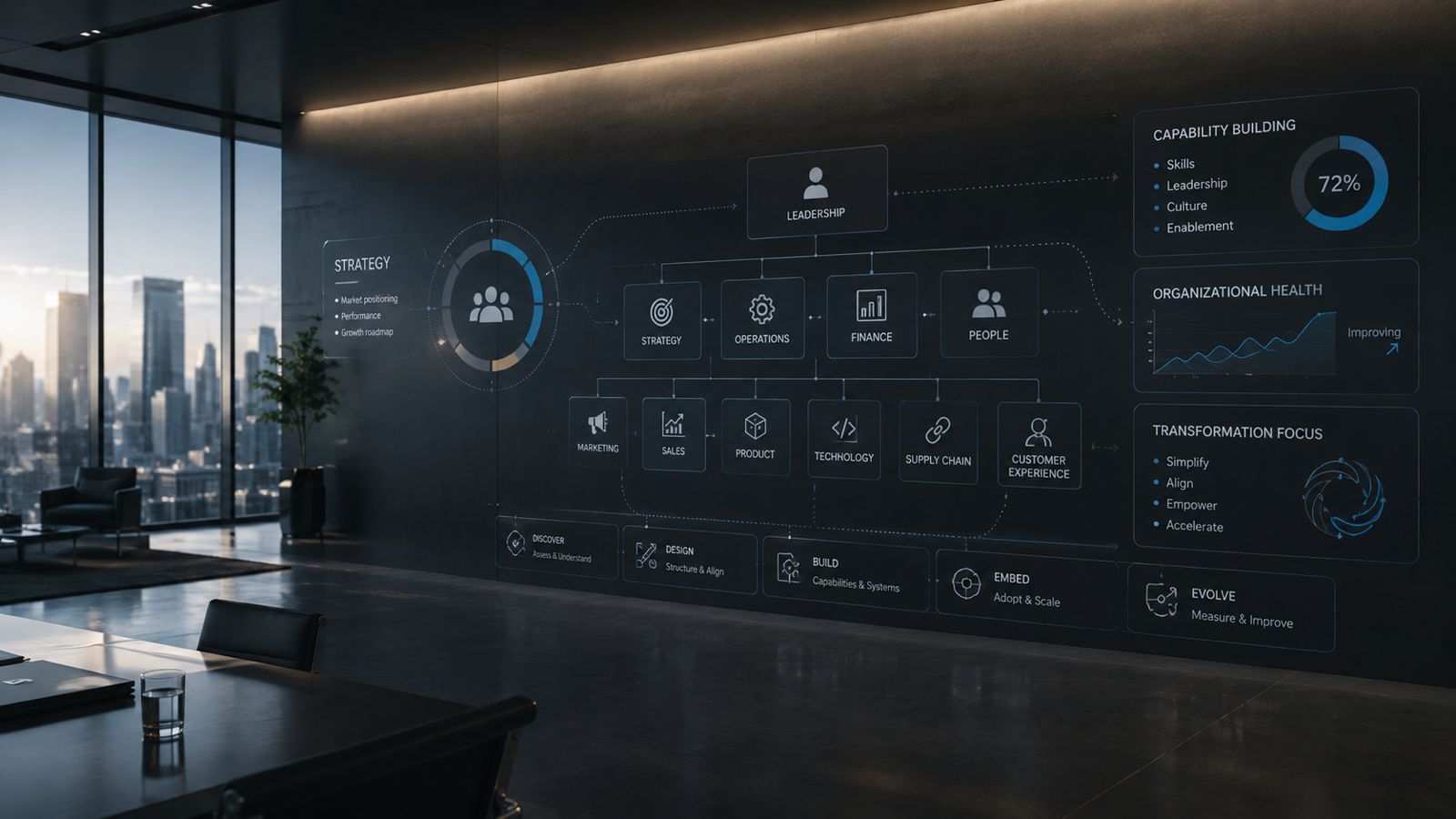
The structure that built the company is the structure that limits it now.
Organizations accumulate; they aren't optimized. Reporting lines reflect history, not strategy. We redesign operating models for decision velocity and scale.
Industry-Specific Organizational Failures
Symptoms of structural decay manifest differently across industries, but the root cause remains the same: misalignment between architecture and ambition.
01 / TECH GROWTH
Founder-centric bottlenecks
Paralyzed decision making post Series B due to legacy control structures.
02 / PRIVATE EQUITY
Legacy Professionalization
Informal structures inhibiting institutional-grade management scale.
03 / CONGLOMERATES
Corporate Center Drag
Bloated headquarters creating administrative friction rather than synergies.
04 / MANUFACTURING
Functional Silos
Preventing the integrated supply chain agility required for modern markets.

Architecting Agility in Legacy Structures
Challenge: A century-old industrial conglomerate faced market share erosion due to slow decision cycles.
Solution: Northrop redesigned the global operating model, shifting from functional silos to customer-centric P&Ls.
Impact: 40% reduction in time-to-market and a revitalized innovation pipeline within 18 months.

"Structure is strategy in motion."
Strategic Outcomes
OPERATING MODEL ARCHITECTURE
Designing the blueprint for how value is created and delivered across the global enterprise.
DECISION RIGHTS MATRIX
Clarifying accountability and governance protocols to eliminate consensus-driven paralysis.
CAPABILITY BUILDING
Identifying and embedding the critical organizational skills required for future state readiness.

Global Insights

The End of the Matrix: Why Speed Demands Simplicity
AI-Ready Structures: How to Rebuild for Automation

The CEO's Playbook for Organizational Transformation